library(elo)
library(BradleyTerry2)

# Fetch and prepare data
df <- irw::irw_fetch("nfl_2010-2019", source = 'comp')
df <- df[order(df$date), ]

# ===== Elo ANALYSIS =====
er <- elo.run(score(score_a, score_b) ~ agent_a + agent_b,
              data = df, k = 20)

# Convert Elo results to long format
elo_results <- as.data.frame(er)
elo_long <- lapply(seq_len(nrow(elo_results)), function(i) {
  data.frame(
    team = c(elo_results$team.A[i], elo_results$team.B[i]),
    elo = c(elo_results$elo.A[i], elo_results$elo.B[i]),
    date = df$date[i]
  )
})
elo_long <- do.call(rbind, elo_long)

# Convert dates to years with decimal (e.g., 2015.5 for mid-2015)
elo_long$year <- elo_long$date/(365*24*60*60)


elo_by_team <- split(elo_long, elo_long$team)

# ===== BRADLEY-TERRY ANALYSIS =====
# Create season variable based on date gaps
date_diff <- diff(df$date)
df$season <- c(0, cumsum(date_diff > 1e7)) + 2010

# Prepare data for BT model
df_bt <- df[df$winner != 'draw', ]
df_bt$win <- as.numeric(df_bt$winner == 'agent_a')
df_bt$agent_a <- factor(df_bt$agent_a)
df_bt$agent_b <- factor(df_bt$agent_b)

# Fit BT models by season
bt_by_season <- lapply(split(df_bt, df_bt$season), function(season_df) {
  mod <- BTm(win, agent_a, agent_b, data = season_df, id = "team")
  co <- coef(mod)
  names(co) <- gsub("team", "", names(co))
  data.frame(
    season = unique(season_df$season),
    est = co,
    team = names(co),
    row.names = NULL
  )
})
bt_results <- do.call(rbind, bt_by_season)
bt_by_team <- split(bt_results, bt_results$team)

# ===== PLOTTING =====
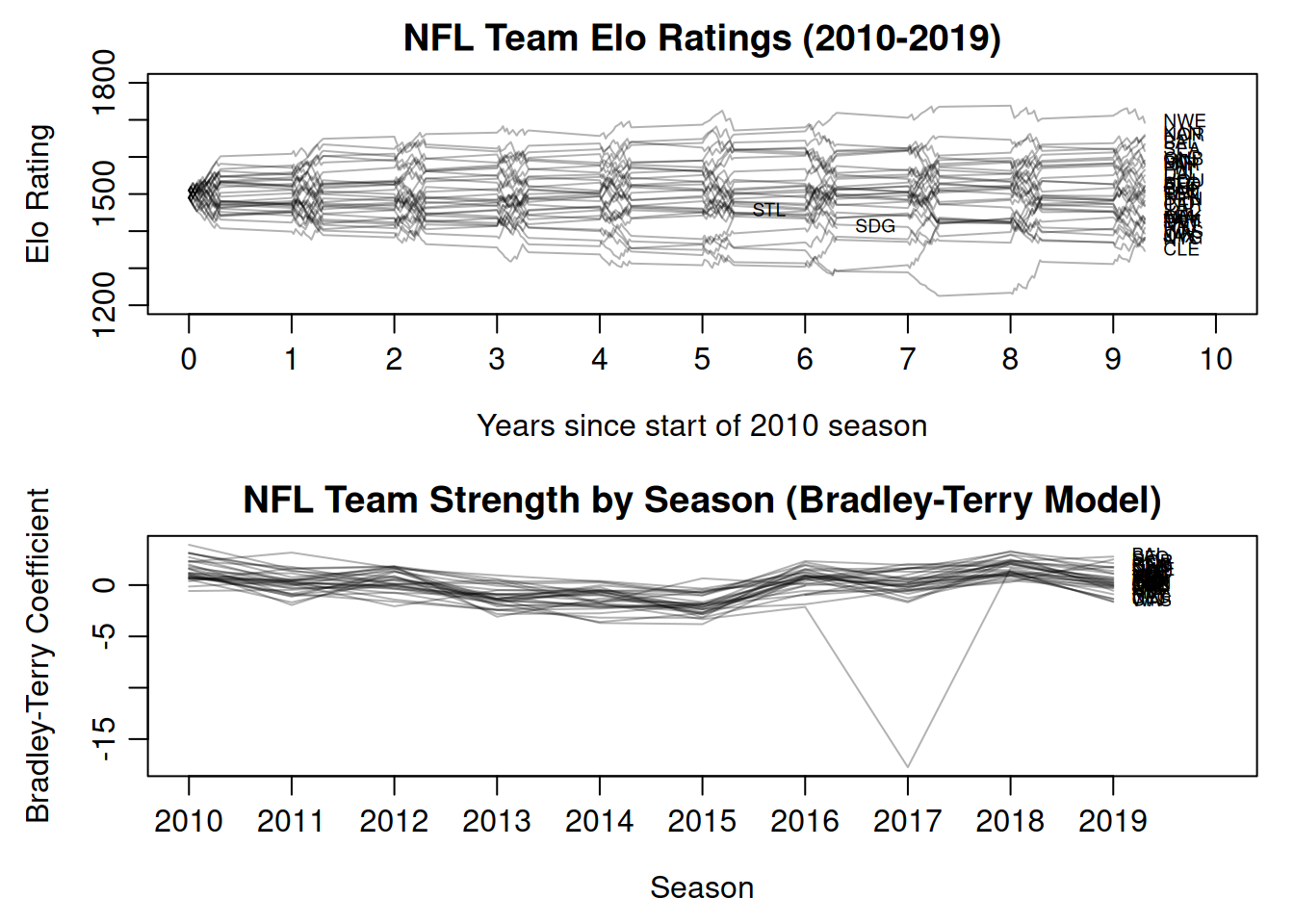
par(mfrow = c(2, 1), mgp = c(2.5, 0.7, 0), mar = c(4, 4, 2, 1))

# Plot 1: Elo ratings over time
plot(NULL,
     xlim = c(0, 10),
     ylim = c(1200,1800),
     xlab = "Years since start of 2010 season",
     ylab = "Elo Rating",
     main = "NFL Team Elo Ratings (2010-2019)",
     xaxt = "n")
axis(1, at = 0:10)

for (team_data in elo_by_team) {
  lines(team_data$year, team_data$elo, col = rgb(0, 0, 0, 0.3))
  n <- nrow(team_data)
  text(team_data$year[n], team_data$elo[n], team_data$team[n],
       pos = 4, cex = 0.6)
}

# Plot 2: Bradley-Terry coefficients by season
plot(NULL,
     xlim = c(2010, 2020),
     ylim = range(bt_results$est,na.rm=TRUE),
     xlab = "Season",
     ylab = "Bradley-Terry Coefficient",
     main = "NFL Team Strength by Season (Bradley-Terry Model)",
     xaxt = "n")
axis(1, at = 2010:2019)

for (team_data in bt_by_team) {
  lines(team_data$season, team_data$est, col = rgb(0, 0, 0, 0.3))
  n <- nrow(team_data)
  text(team_data$season[n], team_data$est[n], team_data$team[n],
       pos = 4, cex = 0.6)
}